

When your business is confronting an imminent and severe threat in Israel—a competitor stealing trade secrets, a partner draining company funds, or a supplier wrongfully withholding critical materials—waiting for a full trial is not a viable option. In these high-stakes moments, interim injunctions in Israeli courts serve as your legal emergency brake, a powerful tool designed to stop irreversible harm before it escalates into a catastrophe.
This is not about the methodical pace of traditional litigation. This is about speed, urgency, and decisive action to protect your assets now.
Understanding Temporary Relief: Your Most Powerful Tool for Urgent Protection
In a high-stakes commercial dispute, time is a luxury you cannot afford. An interim injunction is a rapid court order designed to freeze a dangerous situation, preserving the status quo until the main case can be heard. It is the legal equivalent of hitting an emergency stop button when your business’s future is on the line.
The entire purpose is to prevent a scenario where, even if you win the lawsuit months or years later, the victory is hollow because the damage is already done and cannot be undone.
Israeli courts do not grant these orders lightly. They perform a swift but meticulous balancing act, weighing your urgent need for protection against the potential harm the order might cause the other party. To secure one, you must present a compelling, evidence-backed narrative that leaves no doubt about the imminent danger and the necessity for immediate judicial intervention.
The Four Pillars of an Israeli Interim Injunction Request
To convince a judge to intervene immediately, your request must stand firmly on four key pillars. The court’s decision boils down to a careful evaluation of these essential factors to determine if such a powerful, immediate measure is justified.
Here’s a breakdown of what the court looks for and what it means for your case:
| Key Factor | What It Means for Your Business |
|---|---|
| Prima Facie Case | You must demonstrate that your main lawsuit has a strong probability of success. While this isn’t the full trial, you must present credible initial evidence that your rights have been violated. |
| Balance of Harm | The court will ask: Who stands to suffer more? You must prove that the damage to your business from not granting the injunction far outweighs the harm the defendant would suffer if it is granted. |
| Irreparable Damage | You must show that the harm you face is something money cannot fix later. This includes the loss of trade secrets, destruction of brand reputation, or being forced out of a market. |
| Good Faith and “Clean Hands” | You must have acted honestly and without undue delay. The court will not assist a party that has acted in bad faith or waited too long to seek help after discovering the harm. |
Proving these four elements is crucial. The court is searching for a clear and convincing reason to disrupt the normal course of events, and it is your legal team’s duty to provide it.
The Core Test Your Case Must Pass
Behind all the legal arguments, the court grapples with one fundamental question:
Will failing to act right now cause more harm to the plaintiff than granting the injunction would cause to the defendant?
This “balance of harm” is the absolute heart of the matter. You must tip that scale decisively in your favor by demonstrating two things with clarity and conviction:
- A Strong Initial Case: You must present sufficient evidence at the outset to persuade the judge that your lawsuit is highly likely to succeed. Think of it as a compelling preview of the main event.
- Damage That Can’t Be Undone: You must prove that the harm you face cannot be rectified with a monetary payout down the line. A stolen client list or a tarnished public image can cause damage that no amount of compensation can truly repair.
Securing temporary relief via an interim injunction in Israel is a strategic first strike that can define the entire trajectory of a commercial crisis. It stops the bleeding, shields your most critical assets, and provides the breathing room needed to fight for a favorable resolution from a position of strength.
Stopping Harm vs. Forcing Action: Mandatory vs. Prohibitory Injunctions
In the high-stakes arena of commercial litigation, not all emergencies are created equal, and neither are the legal tools to solve them. When you need urgent court intervention in Israel, you face a critical strategic choice between two distinct types of interim orders: prohibitory and mandatory injunctions. Getting this choice right is paramount to the success of your immediate objective.
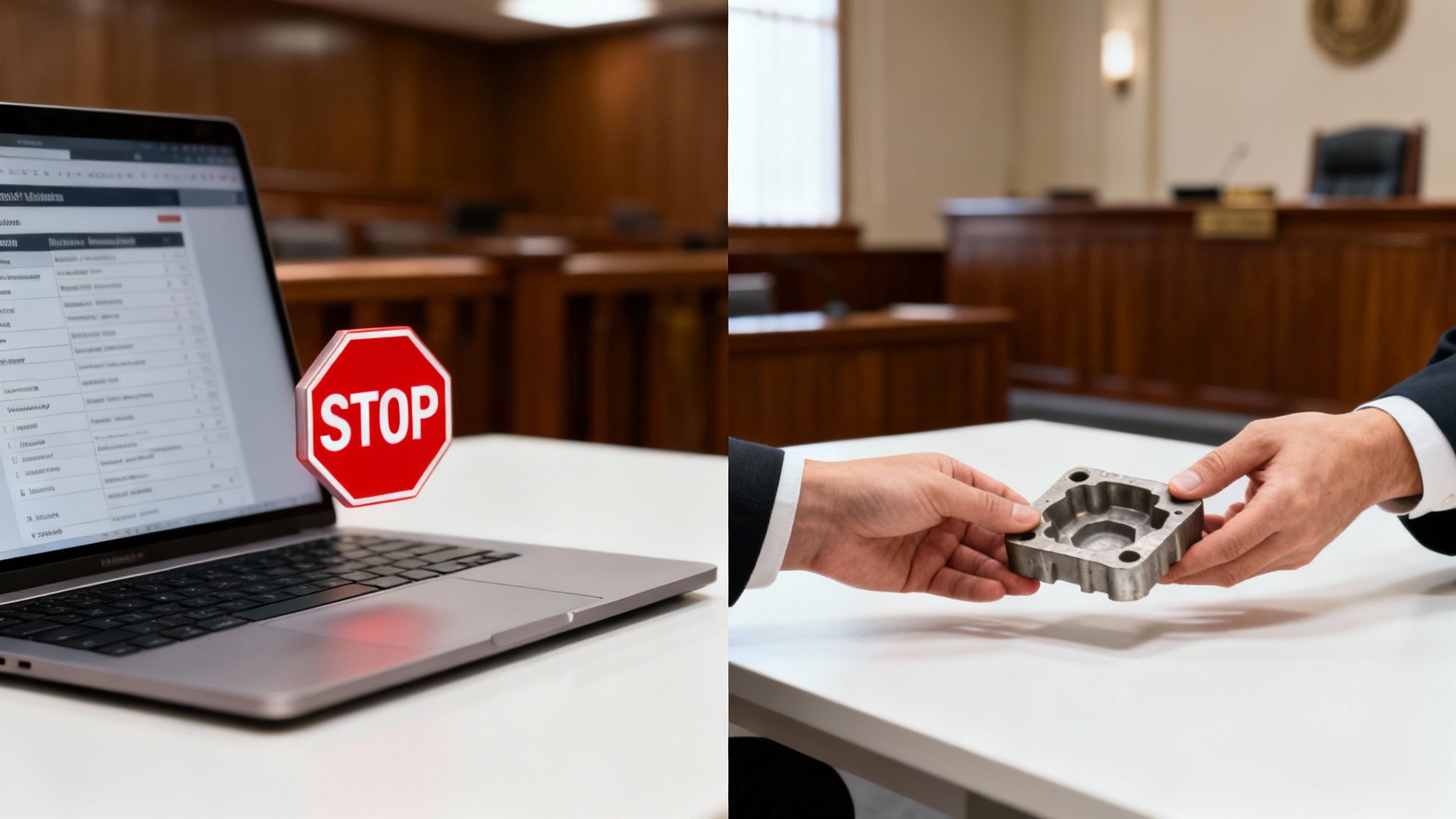
The most common form of temporary relief is the Prohibitory Injunction. Think of it as the court hitting a giant pause button. Its sole purpose is to freeze the current situation—the “status quo”—and stop a harmful action in its tracks.
The Prohibitory Injunction: A Legal Stop Sign
A prohibitory injunction is a court order telling a party to stop doing something. It is a defensive maneuver, a shield designed to prevent damage from worsening while the main legal battle plays out.
For instance, a business might race to court to obtain a prohibitory injunction to:
- Stop a former key employee from using a stolen client list to poach customers.
- Prevent a competitor from launching a product that infringes on its trademark or patent.
- Block a business partner from selling shared company assets without authorization.
Because this type of order simply maintains the existing state of affairs rather than upending it, Israeli courts are generally more willing to grant them. It is an essential tool for protecting your assets and market position from immediate and irreversible harm.
The Mandatory Injunction: An Order to Act
The Mandatory Injunction, in contrast, is a much more aggressive and powerful weapon. It does not just stop an action; it forces a party to take a specific, positive action. This order does not preserve the status quo—it actively changes it.
A mandatory injunction could be used to:
- Force a supplier to return essential manufacturing equipment they are wrongfully withholding.
- Compel a software company to restore access to a critical server or database they have cut off.
- Order a competitor to retract a false and damaging public statement that is destroying your company’s reputation.
Israeli courts consider mandatory injunctions a far more drastic measure. The bar for obtaining one is significantly higher because the court is actively intervening and changing the state of play before all evidence has been heard at trial.
To succeed, your case must be exceptionally strong, and the need for action must be absolutely urgent. The court will demand a much higher level of proof that you are in the right before it compels the other side to act against their will. Choosing the right path—a prohibitory “stop” order or a mandatory “go” order—is a pivotal decision that will shape the immediate outcome of your commercial crisis.
Financial Guarantees: The Price of Securing an Injunction
Requesting an interim injunction from an Israeli court is a powerful legal maneuver that can freeze a defendant’s assets or halt their business operations. Consequently, the courts require you to have significant ‘skin in the game.’ Before granting any temporary relief, the court will demand a financial deposit or guarantee to protect the other party should the injunction prove to be unjustified. This is a non-negotiable requirement.
Think of it as a security deposit. It demonstrates the seriousness of your claim and, more importantly, creates a fund to compensate the defendant for damages suffered while the injunction is active. If you ultimately lose the main lawsuit, that money is available to cover their lost profits, business disruption, or legal costs.

Proving Your Commitment to the Court
The judge has considerable discretion in determining the size and type of the guarantee. The art lies in striking the right balance: it must be substantial enough to genuinely cover the defendant’s potential losses but not so prohibitive that it prevents a legitimate plaintiff from obtaining necessary protection.
Israeli courts typically require one of the following forms of security:
- A Bank Guarantee: This is the gold standard and the most preferred option. It is an unconditional promise from a bank to pay a specified amount on demand, providing the court with maximum confidence.
- A Cash Deposit: A straightforward and effective method where the required funds are deposited directly with the court.
- A Personal Undertaking: This is a sworn statement where you personally pledge to cover any and all damages. While almost always required, it usually supplements a more tangible financial security like a bank guarantee.
Providing a robust financial guarantee does more than satisfy a procedural requirement. It sends a powerful message to the judge: you are confident in your case and ready to back your claims with real assets.
Calculating the Cost of Protection
Determining the appropriate amount for the guarantee is a strategic calculation. The court considers the defendant’s potential losses, the nature of the business being impacted, and the strength of your initial evidence. For international entities seeking urgent relief in Israel, having this financial component of the strategy ready is absolutely critical.
A well-judged and promptly delivered guarantee can dramatically strengthen your application. It signals that you are prepared, responsible, and have unwavering faith in your position—qualities that carry significant weight in the Israeli judicial system.
Same-Day Urgency: How to Get an Immediate Court Decision
In a true business crisis, you don’t have days—you have hours. When a threat is so immediate that notifying the other party would trigger the very damage you are trying to prevent, the Israeli legal system provides an extraordinary tool: the ex parte application for an interim injunction. This is your legal lifeline for securing a same-day court decision.
This high-stakes maneuver allows you to approach the court without the defendant being present or even aware of the proceeding. It is a tool reserved for genuine emergencies where the element of surprise is your only defense against irreparable harm.

When Every Second Counts
Imagine you discover credible evidence that your joint venture partner is planning to illegally transfer all shared intellectual property to an offshore account at midnight. Notifying them of a court hearing would be tantamount to giving them a head start.
This is precisely the type of ticking-clock scenario the ex parte application was designed for. The process is built for maximum speed. Your legal team can file an urgent motion and often secure a hearing with a judge within hours, potentially on the very same day.
The core argument in an ex parte hearing is that the risk of tipping off the defendant is greater than the risk of hearing only one side of the story. You must convince the judge that immediate, unilateral action is the only way to preserve the assets or rights at stake.
The High Burden of an Ex Parte Request
Because this process bypasses the fundamental legal principle of hearing both sides, the court imposes an extremely high burden of proof on the applicant. You must demonstrate not just the standard requirements for an injunction but an exceptional level of urgency that justifies such a drastic step.
To succeed, you must present a meticulously prepared case that includes:
- Irrefutable Evidence: Clear, compelling proof of the imminent threat. This is not the time for speculation.
- Full Disclosure: You have an absolute duty to present all relevant facts to the court, including those that might weaken your case. Hiding information is grounds for immediate dismissal and can have severe consequences.
- A Substantial Financial Guarantee: Courts almost always require a higher-than-usual security deposit to compensate the absent defendant for potential damages from an order they had no chance to contest.
Securing an ex parte order is a testament to the Israeli judiciary’s ability to act with decisive speed. The court will typically grant the injunction for a very short period—often just a few days—and schedule an urgent hearing where both parties can argue the case. It is a powerful first step that can be the critical move to save your business from catastrophic, irreversible loss.
When Global Politics and Local Lawsuits Collide
For any multinational company with a footprint in Israel, legal headaches are rarely just a local affair. A standard commercial dispute in a Tel Aviv court has a predictable playbook. But things get complicated—fast—when international legal and political pressures crash the party. A ruling from an international tribunal or shifting geopolitical tides can instantly create a volatile business climate, demanding a far more sophisticated risk management strategy than what’s needed for a simple domestic lawsuit.
This is especially true when global bodies like the International Court of Justice (ICJ) issue provisional or interim measures. These aren’t your typical interim injunctions Israel‘s courts grant every day. They add a layer of global complexity that can shake investor confidence, disrupt supply chains, and tarnish a corporate reputation on a worldwide scale. The real challenge for foreign entities is learning to fight a war on two fronts: managing the immediate local dispute while shielding the business from the fallout of these international legal tremors.
The Balancing Act: Juggling Local and Global Legal Realities
A domestic injunction is a known quantity; it’s a direct legal tool with clear rules. An international ruling, however, throws a wrench in the works, introducing variables that demand serious crisis management expertise.
Take, for example, the recent provisional measures issued by the ICJ against Israel, which came with demands for compliance reports on incredibly tight deadlines. For an international CEO, this is a flashing red light. It shows how global judicial actions can create operational and reputational headwinds—a dynamic far less common in the U.S. or EU, where such binding international orders are rare. This reality brings the need for sharp, experienced legal counsel into focus; you need a team that can navigate both the intricacies of local Israeli court procedure and these powerful international pressures. You can explore the nuances of these ICJ interim measures to understand their broader impact.
A company can easily find itself trapped, trying to comply with a local Israeli court order while simultaneously managing the reputational damage and operational risks flowing from a directive issued by a tribunal in The Hague. This is precisely where a proactive, multifaceted legal strategy becomes non-negotiable. It’s no longer just about winning a case; it’s about protecting the business from every possible angle.
Your legal strategy has to be agile enough to handle the immediate demands of a commercial lawsuit in a Tel Aviv courtroom while, at the same time, preparing for the reputational and strategic fallout from a ruling in The Hague. This requires a seamless fusion of high-stakes litigation and crisis management.
Building this kind of robust defense means deeply understanding how these two legal worlds interact and influence one another. A winning approach doesn’t just react; it anticipates how a decision in one arena could trigger a crisis in the other. For any global corporation operating in today’s interconnected legal landscape, this dual focus isn’t a luxury—it’s an absolute necessity for protecting your investments and business interests against complex, cross-border threats.
When Is It Time to Hit the “Emergency Stop” Button with an Interim Injunction?
Knowing how to file for an interim injunction is one thing. Knowing precisely when to pull the trigger is an entirely different ballgame. Move too soon, and you risk a costly legal misstep. Wait a moment too long, and any future court victory might be completely worthless.
This isn’t about theoretical legal strategy; it’s a practical playbook for those critical moments when a business crisis demands immediate, decisive action. In certain scenarios, waiting for the standard legal process to unfold is like watching your house burn down while waiting for a scheduled fire department visit. You need to act now.
Identifying the Tipping Point
The decision to seek one of the most powerful interim injunctions Israel has to offer comes down to one crucial question: Is a manageable problem about to become an irreversible catastrophe? Think of the following situations as giant red flags—moments that scream for swift legal intervention.
Here are concrete examples where the courts are often the only emergency brake you have:
- Active Intellectual Property Heist: You’ve just discovered a departing executive is in the middle of downloading your entire client database or, worse, your proprietary source code. An injunction can freeze that transfer in its tracks, preventing your competitive advantage from being sold to the highest bidder.
- Brazen Non-Compete Violation: A key manager, still bound by a non-compete clause, resigns on Friday and opens a rival firm on Monday. They’re not just competing; they’re actively poaching your top clients using the confidential playbook they learned while on your payroll.
- Hostile Boardroom Coup: A shareholder dispute boils over. A rogue faction attempts an illegal boardroom maneuver to seize control, threatening to liquidate assets or lock out the legitimate management team.
- Weaponized Data Leaks: A business partner dispute turns ugly. Suddenly, sensitive trade secrets or embarrassing internal emails are being leaked to competitors or the press, causing immediate and catastrophic damage to your brand and market position.
In every one of these scenarios, the damage is happening in real-time. A check for monetary damages awarded two years down the line won’t magically restore your stolen trade secrets, win back your lost market share, or rebuild shattered public trust.
The core principle is this: An injunction is the right tool when the threat is active, the damage is ongoing, and the consequences of doing nothing are both catastrophic and permanent.
The Nuances of the Israeli Legal Landscape
Understanding these triggers is essential, but it’s only half the story for foreign investors. The Israeli judicial system has its own unique rhythm and history. How the Israeli Supreme Court has approached emergency relief in the past casts a long shadow, influencing how lower courts weigh these urgent requests.
In some contexts, factors that go beyond pure commercial harm—like national security concerns—have historically shaped judicial thinking. This has created a legal environment with distinct nuances. Unlike many Western jurisdictions where proving irreparable commercial harm is the be-all and end-all, Israeli courts can sometimes view these matters through a wider lens. This is a critical distinction for any CEO navigating a dispute in Israel. It underscores why a strategy informed by deep local expertise, which may even prioritize an out-of-court solution, can often be the smarter play. To get a sense of how broader issues can shape legal relief, one can review materials like the Commission of Inquiry’s report.
Having this strategic insight allows you to spot the critical red flags early, act with precision, and protect your business before a crisis spins completely out of control.
The Strategic Imperative: Acting Decisively in High-Stakes Legal Action
Getting an interim injunction in Israel isn’t just about knowing the law. It’s about speed, strategic thinking, and absolute precision under pressure. Throughout this guide, we’ve broken down the essential pieces of this powerful legal tool—from the different types of relief available to the critical need for financial undertakings and, most importantly, the urgency required when every second is critical.
Our firm’s 30-plus years of experience weren’t just earned in courtrooms; they were forged in the fire of these exact high-stakes scenarios for international companies. We have a deep, practical understanding of the procedural maze and judicial mindset that truly define the landscape for interim injunctions in Israel.
Beyond the Courtroom: Your Strategic Advantage
We don’t just see a legal problem; we see the bigger picture. Our specialty lies at the intersection of crisis management and complex litigation, allowing us to anticipate the next move and protect your business’s long-term health and reputation. This means we’re not just aiming to win a motion in court. Often, the real victory is engineering a decisive, out-of-court solution that protects your interests while saving you precious time and money.
The most effective legal strategy is one that anticipates conflict, manages crises proactively, and uses litigation as a precise tool—not a first resort. Our deep experience in both the courtroom and the boardroom gives our clients a distinct advantage in protecting their assets.
If your business is facing a clear and present danger that threatens your operations or assets in Israel, the window for action is small and shrinking fast. The choices made in the next few hours and days will dictate the outcome. In these situations, immediate, expert legal counsel isn’t just a good idea; it’s absolutely essential.
At RNC Group, we provide immediate, strategic consultations to help you safeguard your assets and ensure business continuity. Contact us to learn how our cross-border expertise can deliver the urgent relief you need.
Learn more about our litigation and crisis management services
This article does not constitute legal advice and is not a substitute for consulting with a qualified attorney. Do not rely on the contents of this article for taking or refraining from taking any action.